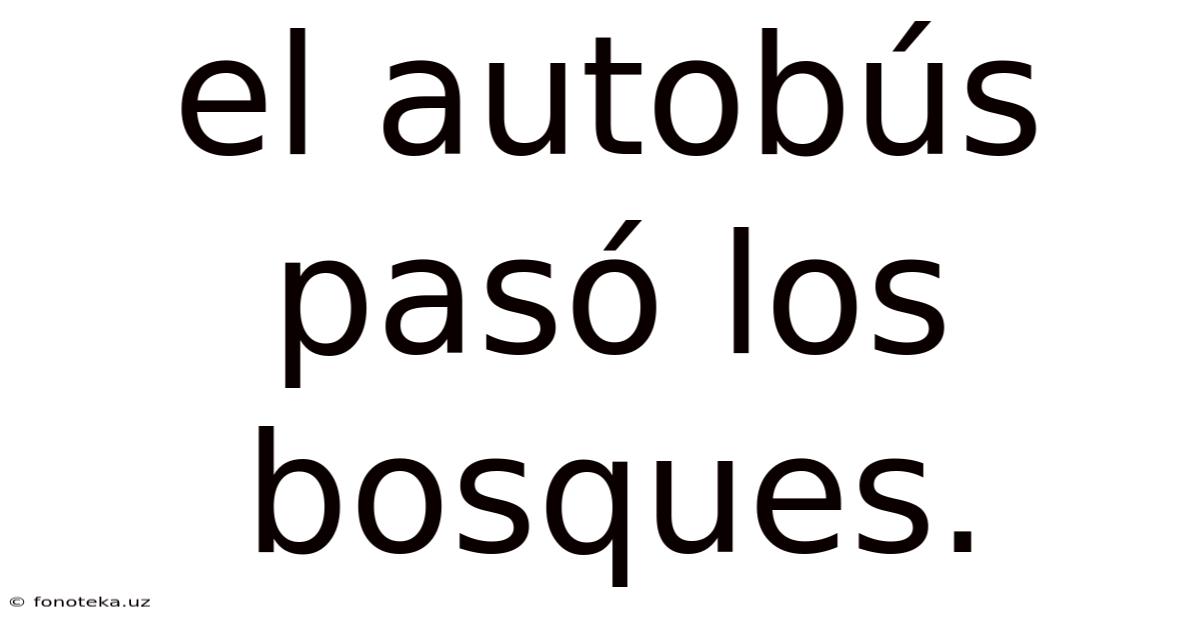
El Autobús Pasó los Bosques: A Journey Through Narrative and Meaning
El Autobús Pasó los Bosques – "The Bus Passed Through the Woods" – is more than just a simple sentence; it's a springboard for countless narratives, interpretations, and explorations of meaning. That said, this seemingly straightforward phrase evokes a sense of journey, transition, and the unknown, leaving the reader to fill in the gaps with their own imagination and experiences. This article delves deep into the potential meanings, exploring its literary applications, symbolic interpretations, and the possibilities it unlocks for creative writing and personal reflection Small thing, real impact..
The Power of Simplicity: Deconstructing the Sentence
The beauty of "El Autobús Pasó los Bosques" lies in its simplicity. It uses common, easily understood words, yet it holds a surprising depth. Consider this: the sentence's structure itself is linear, mirroring the journey implied: a clear subject (the bus), a verb of motion (passed), and a clear object (the woods). This straightforwardness allows the reader to focus on the connotations and implications rather than struggling with complex syntax.
The choice of "autobús" (bus) suggests a public mode of transportation, implying a shared experience, possibly a journey with multiple individuals, each with their own story and destination. This contrasts with the solitude often associated with journeys through forests, creating an immediate tension between the communal and the solitary.
This is where a lot of people lose the thread.
"Bosques" (woods), in its plural form, hints at a significant expanse of woodland, not just a small copse of trees. Consider this: this suggests a journey of some length and perhaps a journey into the unknown, a transition from the familiar to something less defined. The woods themselves carry a rich symbolic weight, often representing mystery, danger, transformation, and the subconscious.
Narrative Possibilities: Where the Journey Leads
The sentence "El Autobús Pasó los Bosques" invites us to imagine the story surrounding it. Where did the bus originate? Worth adding: where is it headed? Practically speaking, who are the passengers? Consider this: what are their motivations? The possibilities are endless.
Possible Narratives:
- A mundane journey: The bus could be on a regular route, carrying commuters to their daily lives. The passing of the woods is simply a part of the journey, a brief interlude in the routine.
- A journey of escape: The bus could be carrying individuals fleeing from a difficult situation, seeking refuge or a new beginning. The woods represent a transition from a painful past to a hopeful future.
- A supernatural journey: The woods could be imbued with magic or mystery. The bus journey could be a vehicle for a supernatural event, a meeting with the uncanny, or a descent into a fantastical realm.
- A coming-of-age story: The journey through the woods could represent a young person's journey of self-discovery, a metaphorical passage from childhood to adulthood. The bus, a symbol of society, contrasts with the individual's personal transformation.
- A social commentary: The bus could represent social structures and inequalities, with the woods representing a hidden or overlooked aspect of society. The journey could reveal social injustices or hidden truths.
The ambiguity of the sentence allows for a wide range of interpretations, making it a powerful tool for narrative creation.
Symbolic Interpretations: Delving Deeper into Meaning
Beyond specific narratives, "El Autobús Pasó los Bosques" is rich in symbolic potential.
- Journey and Transition: The most obvious symbol is the journey itself. The bus passing through the woods represents a transition from one state to another, a movement from the known to the unknown, from the familiar to the unfamiliar.
- The Woods as the Subconscious: In literature and psychology, woods are often symbolic of the subconscious mind. The bus's passage through the woods could represent a journey into the depths of one's own psyche, confronting hidden fears, desires, and memories.
- Nature vs. Civilization: The contrast between the bus, a symbol of civilization and technology, and the woods, a symbol of nature and the wild, highlights the ongoing tension between humanity and the natural world.
- Loss of Innocence: The journey through the woods could represent a loss of innocence, a confrontation with the darker aspects of life. The bus passengers might experience a transformative event during their passage.
- Hope and Renewal: Despite potential dangers, the woods can also symbolize hope and renewal. The journey through them could represent a period of growth and transformation, leading to a brighter future.
Expanding the Narrative: Literary Techniques
To expand on "El Autobús Pasó los Bosques," writers can use various literary techniques:
- Imagery and Sensory Detail: Vivid descriptions of the woods – the smell of pine needles, the rustling of leaves, the dappled sunlight filtering through the trees – can enhance the reader's experience and deepen the emotional impact.
- Character Development: Developing the passengers' personalities and motivations will enrich the narrative. What are their relationships? What are their hopes and fears?
- Setting the Tone: The tone can range from peaceful and contemplative to suspenseful and ominous, depending on the narrative chosen. The use of language and imagery can help establish the appropriate mood.
- Conflict and Resolution: Introducing conflict, either internal or external, will create tension and drive the narrative forward. The resolution of the conflict will determine the overall meaning of the journey.
- Symbolism and Allegory: Using the bus and the woods as symbols to represent broader concepts and themes will add layers of meaning and complexity to the narrative.
El Autobús Pasó los Bosques: A Creative Writing Exercise
The sentence itself can serve as a prompt for creative writing exercises:
- Short Story: Write a short story based on the sentence, developing the characters, setting, and plot. Explore the different narrative possibilities discussed above.
- Poem: Write a poem inspired by the image of the bus passing through the woods. Use vivid imagery and sensory details to capture the atmosphere and mood.
- Script: Write a scene from a play or movie based on this sentence. Explore the dialogue and interactions between the passengers.
Frequently Asked Questions (FAQ)
Q: What is the most important aspect of interpreting "El Autobús Pasó los Bosques"?
A: The most important aspect is acknowledging the inherent ambiguity and allowing your own creativity and interpretation to shape the meaning. There is no single "correct" answer.
Q: How can I use this sentence as a starting point for a longer work?
A: Consider expanding on the "why" and "who" elements. Why is the bus traveling through the woods? Who are the passengers and what are their individual stories? These questions will help you flesh out a longer narrative.
Q: What genres would be best suited to explore this sentence?
A: Many genres would work well, including magical realism, mystery, adventure, coming-of-age stories, and even social commentary. The sentence's versatility allows for diverse creative exploration The details matter here..
Conclusion: A Journey Worth Taking
"El Autobús Pasó los Bosques" is a deceptively simple sentence that holds a wealth of potential for narrative exploration and symbolic interpretation. Consider this: the sentence's power lies in its ability to spark the imagination, leaving the reader to embark on their own unique interpretation of the journey and the destination that lies beyond the woods. The journey through the woods, whether literal or metaphorical, is a journey worth taking, a journey that holds the promise of discovery, transformation, and profound meaning. Its ambiguity invites readers and writers alike to engage with the text on multiple levels, fostering creativity and deeper understanding. The possibilities are limitless, and the exploration is richly rewarding It's one of those things that adds up..
