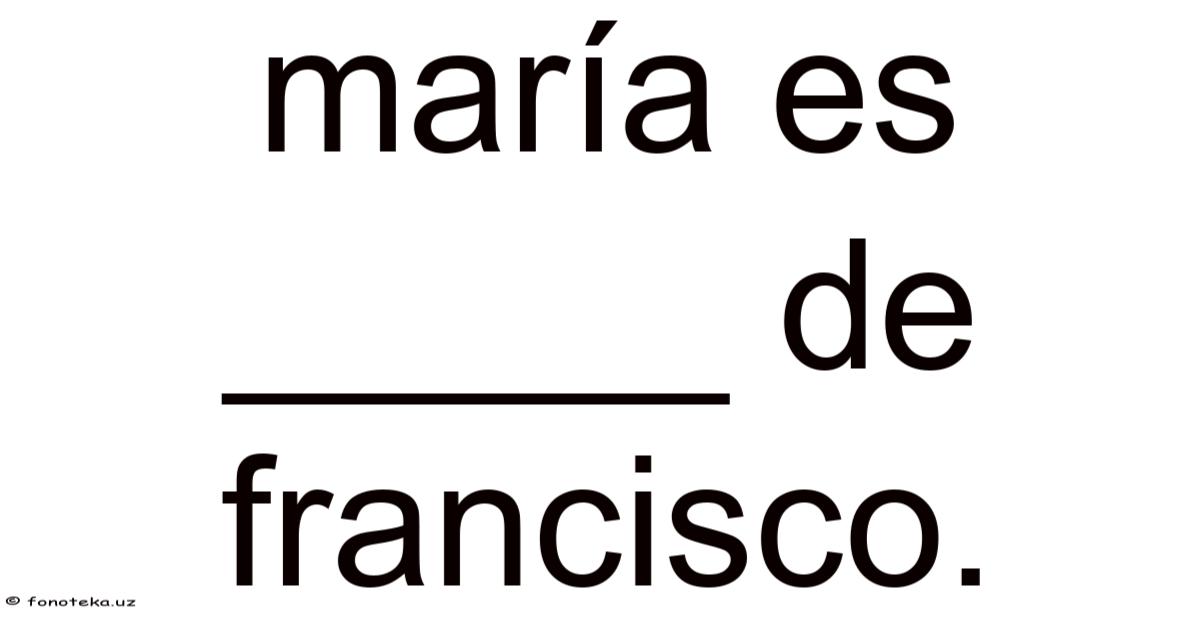
María Es _____ De Francisco: Exploring the Grammatical and Contextual Possibilities
This article looks at the seemingly simple sentence "María es _____ de Francisco," exploring the numerous possibilities for the blank, analyzing the grammatical implications, and examining the diverse contextual nuances that arise depending on the word chosen. Now, we'll go beyond simple vocabulary lessons to understand the deeper implications of choosing specific words, examining the relationships implied and the cultural subtleties conveyed. This comprehensive exploration will provide a reliable understanding of Spanish grammar and its application in diverse situations Simple as that..
Understanding the Basic Structure
The sentence "María es _____ de Francisco" utilizes the verb "ser" (to be), indicating a state of being or a permanent attribute. On top of that, the structure is Subject (María) + Verb (es) + Predicate. The blank represents the predicate nominative, which will define María's relationship to Francisco. This relationship can be familial, professional, social, or even spatial. The preposition "de" (of) indicates possession, origin, or relationship.
Exploring Potential Words and their Contexts
Let's explore a range of words that can effectively fill the blank, categorizing them for clarity and examining the subtle differences in meaning:
1. Family Relationships:
-
María es la esposa de Francisco: (María is Francisco's wife) This establishes a marital relationship, implying a legally binding union and a significant level of intimacy. The use of "la esposa" (the wife) is specific and definitive.
-
María es la novia de Francisco: (María is Francisco's girlfriend) This indicates a romantic relationship, but one that is not necessarily formal or legally binding. The implication is a less committed relationship than marriage.
-
María es la hija de Francisco: (María is Francisco's daughter) This clarifies a paternal relationship. "Hija" (daughter) clearly defines María's familial status.
-
María es la madre de Francisco: (María is Francisco's mother) This reverses the relationship, establishing María as Francisco's parent. "Madre" (mother) conveys a significant familial bond Not complicated — just consistent..
-
María es la hermana de Francisco: (María is Francisco's sister) This indicates a sibling relationship, sharing a common parent or parents. "Hermana" (sister) implies a close familial connection Took long enough..
-
María es la prima de Francisco: (María is Francisco's cousin) This depicts a more distant familial connection than siblings, but still within the family network. "Prima" (cousin) indicates a shared ancestry.
2. Professional Relationships:
-
María es la secretaria de Francisco: (María is Francisco's secretary) This establishes a professional working relationship, where María works for Francisco in an administrative capacity. "Secretaria" (secretary) specifically defines the role That alone is useful..
-
María es la jefa de Francisco: (María is Francisco's boss) This reverses the professional hierarchy, placing María in a position of authority over Francisco. "Jefa" (boss) clearly indicates a superior-subordinate relationship Surprisingly effective..
-
María es la colega de Francisco: (María is Francisco's colleague) This signifies a professional peer relationship, working together at the same level. "Colega" (colleague) suggests collaboration and shared professional tasks.
-
María es la cliente de Francisco: (María is Francisco's client) This implies a business relationship where Francisco provides services to María. "Cliente" (client) describes a customer-provider dynamic.
3. Social Relationships:
-
María es la amiga de Francisco: (María is Francisco's friend) This indicates a personal relationship based on friendship and companionship. "Amiga" (friend) suggests a bond of mutual respect and affection.
-
María es la vecina de Francisco: (María is Francisco's neighbor) This establishes a spatial relationship, indicating that María lives near Francisco. "Vecina" (neighbor) defines proximity, not necessarily a close personal relationship.
4. Other Relationships and Contexts:
-
María es la dueña de Francisco: (María owns Francisco) This is unusual and could be interpreted in multiple ways, either figuratively (as in owning a business Francisco works for), or literally (which is ethically problematic). The context would be essential for clarification Not complicated — just consistent..
-
María es la imagen de Francisco: (María is the image of Francisco) This uses "imagen" (image) in a metaphorical sense, possibly relating to María being a representative or symbol of Francisco But it adds up..
-
María es la inspiración de Francisco: (María is Francisco's inspiration) This is a figurative relationship indicating that María motivates or inspires Francisco. "Inspiración" (inspiration) points to a source of motivation or creativity Practical, not theoretical..
Grammatical Considerations:
The choice of word impacts the agreement between the subject and predicate. The adjective or noun used must agree in gender (feminine in this case, because of "María") and number (singular). Ignoring this rule would be a grammatical error Worth keeping that in mind. Which is the point..
Understanding the Nuances of "De"
The preposition "de" matters a lot. It doesn't simply mean "of" in a direct translation. It indicates a relationship, possession, origin, or material. The specific meaning of "de" is heavily dependent on the word that follows it Surprisingly effective..
Cultural Context
The interpretation of the sentence can be influenced by cultural context. Take this: the level of formality in addressing family members varies across Spanish-speaking cultures.
Conclusion
The seemingly simple sentence "María es _____ de Francisco" offers a rich tapestry of possibilities. The choice of word reveals not only the relationship between María and Francisco but also unveils subtle nuances of formality, intimacy, and cultural context. By understanding the grammatical structure, the diverse vocabulary options, and the role of "de," we can appreciate the depth and complexity embedded within this concise Spanish sentence. Careful consideration of the appropriate word is essential for accurate and effective communication Which is the point..
You'll probably want to bookmark this section Small thing, real impact..
Frequently Asked Questions (FAQ)
-
Q: Can the blank be filled with any noun? A: No, the noun must logically fit into the context of the sentence and agree in gender and number with "María."
-
Q: Is "María es la perro de Francisco" grammatically correct? A: No, it's grammatically incorrect. "Perro" (dog) is masculine and does not agree with the feminine subject "María." This would require a different sentence structure.
-
Q: How does the context influence the meaning? A: Context is crucial. The same word could have different interpretations depending on the surrounding information and the overall narrative. As an example, "amiga" in a formal setting might imply a professional acquaintance, whereas in an informal setting it would suggest a close friend.
-
Q: What if I want to express a more complex relationship? A: More complex relationships might require a longer phrase or sentence rather than a single word in the blank. As an example, "María es una amiga muy cercana de Francisco" (María is a very close friend of Francisco) Worth knowing..
-
Q: Are there any other prepositions that could replace "de"? A: While "de" is the most common and appropriate preposition in this context, other prepositions might be possible depending on the specific relationship. Take this: "con" (with) could be used if describing a companionship rather than a defined relationship. Even so, "de" most accurately reflects the possessive or relational nature suggested in the base sentence.
This detailed exploration of "María es _____ de Francisco" offers a comprehensive understanding of how seemingly simple sentences can reveal complex relationships and cultural nuances in the Spanish language. Remember, mastering a language goes beyond simply memorizing vocabulary; it involves understanding the underlying grammar and context that give words their true meaning and power The details matter here..
